Hotel plans improve with input

Original Published May 18, 2017
Frederick News-Post Editorial

It takes time to do big things. As Mayor Randy McClement observed Thursday, it has taken eight years to produce the latest vision of the proposed downtown hotel and conference center.

It’s been worth the wait.

The plan, sketches and model unveiled before a packed room at the Delaplaine Visual Arts Education Center show a project that is coming together beautifully. In its scale, in its design and even in the financing behind it all, the revised proposal shows that developers have taken account of community feedback — and criticism — in refining the project.

The new design for the hotel and conference center would be lower — four floors instead of five — and it would have fewer rooms — 180 instead of 240. The reduced mass and height of the building will preserve views of Frederick’s iconic steeples, answering a concern raised by the initial sketches. And we are especially pleased to learn that the hotel will provide public access to the rooftop, for all of us to enjoy the views.

The new design shows thoughtful consideration of the project’s setting, in the heart of Frederick’s historic downtown, along the city’s centerpiece Carroll Creek Linear Park. Parking will be underground and out of sight. Lining the creek will be the hotel lobby, a restaurant and meeting space, bringing hotel activity right to the creek. The new design is also sensitive to how the building meshes with the streetscape along Patrick and Carroll streets, reinvigorating the historic trolley building on Patrick and providing street-level access to new shops and restaurants along Carroll.

Critically, public officials and developer Pete Plamondon, of Plamondon Hospitality Partners, have clarified the role that public funding will play in bringing this project to Frederick. What opposition there has been to the project has largely centered on the use of public money. Officials emphasized that no public money will be spent building or operating the hotel or the conference center.

Public money is still required — about $30 million from state, county and city sources. It will be used for “land acquisition, grading and site preparation, utilities, on-site public parking and related off-site roadway improvements,” according to a city press release.

That’s entirely appropriate. Most of the money would be generated by the project itself, so it isn’t being pulled from other uses. That public money wouldn’t exist without the project. More importantly, this project has the potential to be transformational for downtown Frederick. It would add momentum to development all along the creek and provide a vital link between downtown and east Frederick. It would help large local businesses that need gathering spaces. And by attracting thousands of visitors downtown, the hotel and conference center will bring cultural vitality to the city — and revenue to shops and local restaurants.

In supporting jobs, tax revenue and an active, attractive downtown, this is exactly the kind of smart public-private partnership that builds great cities like Frederick. It benefits all of us, the very definition of a public investment.

There is still more to be done, of course. Among other steps, the developers will need to work with the Historic Preservation Commission to ensure their plans meet city guidelines. We trust the HPC will work productively on the project. And the developers will need approval to remove a small vacant building on the site known as the Birely Tannery.

The fate of the Birely Tannery has been another flashpoint in the public discussion about the hotel and conference center. Plamondon said removing the Birely Tannery was necessary, but that element of the city’s tanning history would be incorporated into the project. Some of that was on display at the unveiling; the architect pointed out creek-side trellises that reference drying racks used in tanning operations. That approach, we believe, offers a reasonable compromise to honoring the city’s industrial past while building for the future.

At the end of the presentation, McClement called to the front of the room some of the people who have worked to push this project forward. It was a long line of public officials and community members, too many to mention them all by name here. But it was maybe the best part of the whole event, because it showed just how many people have invested so much time and effort in making this happen. With that kind of broad support, and with the willingness to adapt to community input that was shown in the latest plans, we are confident Frederick will get the downtown hotel and conference center it deserves.
Fewer rooms, more parking, new funding breakdown included in latest downtown Frederick hotel plans

Original Published May 18, 2017
Frederick News-Post

By Mallory Panuska mpanuska@newspost.com 

                                                                      &nbs…

                                                                                                                                                                                               Staff photo by Graham Cullen

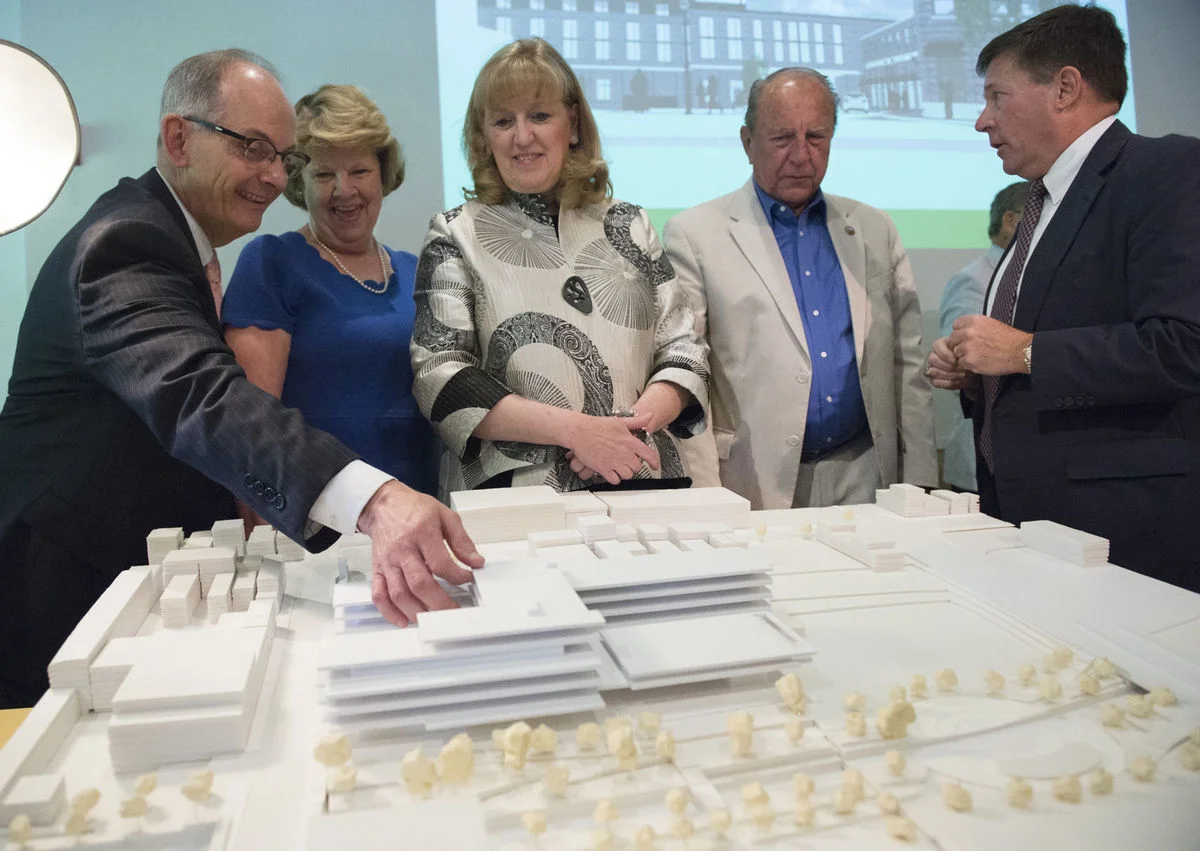
From left, Frederick Mayor Randy McClement, state Delegate Carol Krimm, County Executive Jan Gardner, County Council President Bud Otis and Peter Plamondon Jr., CEO of Plamondon Hospitality Partners, mingle after unveiling of a model of the proposed downtown hotel and conference center on Thursday at the Delaplaine Visual Arts Education Center. 

The city and county’s contribution is expected to amount to between $14 million and $16 million, depending on final design approvals.

Maryland lawmakers passed a capital budget in late March that tentatively includes $16 million in grants for the project. Through that plan the project would receive a $5 million grant in fiscal 2018. Other amendments include a $7.5 million grant preauthorization for fiscal 2019 and a $3.5 million grant preauthorization for fiscal 2020.

The money is not a sure thing yet, as the state Board of Public Works still has to release the funds. McClement said Thursday that he is working out a schedule to determine when the board will hear the request.

Republican lawmakers have opposed state funding for the project and have said they will try to keep the money from being released.


Historic preservation

The architects plan to restore the historic elements of the Birely Tannery site as they move forward with the request to demolish the building. The next step is taking the plans to the city’s Historic Preservation Commission, which architects Marty Bates and Jim Mills said should occur shortly.

Plamondon said the decision to remove the tannery building was not an easy one.

“We do not take the removal of the former Birely Tannery building lightly,” he said. “But it’s necessary as this location is the only feasible option for a full-service hotel in this economic climate.”

Officials hired Bates Architects roughly seven months ago to complete the design because of the Frederick firm’s experience and expertise in historic preservation and rehabilitation.

“We’re always interfacing with city offices, planning offices and the Historic Preservation Commission,” Bates said. “We know the players, we know the workings and we know the community.”

Bates and Mills said they plan to involve the community in future discussions about preservation of the elements of the tannery site to ensure the history is not lost.

They are also excited about the plans to rehabilitate the former News-Post building into a retail facility, which they hope will include a featured restaurant and shops.

The red brick building was constructed in 1910 and used as an all-in-one terminal, waiting room, ticket office and freight depot for the Frederick & Middletown Railway. The Potomac Edison Co. also had its headquarters there and operated a 17-mile stretch of trolley line from Frederick to Thurmont. The News-Post moved there in 1968.

“It’s a gem, architecturally speaking.” Mills said of the building. “We’re just bringing it back to life.”


A long-awaited
step forward

If all goes as planned, officials hope to begin construction by 2018, with a tentative 2020 opening.

The design unveiled Thursday was the first solid, detailed plan developers have released.

The plans have been in the works for roughly eight years, McClement said, and Thursday’s design reveal was something those who have been working on it have been anticipating for a long time.

McClement said that downtown Frederick is becoming more of a destination and a hotel of this caliber coincides perfectly with that. He and Gardner also thanked everyone who helped move the project along, including members of the Board of Aldermen, County Council, state Legislature, Frederick County Chamber of Commerce, Downtown Frederick Partnership, and Tourism Council of Frederick County.

“This hotel and meeting space will be the crown jewel and much-needed element to the infrastructure of our downtown,” McClement said. “I look forward to having everyone who is here today join us when we cut the ribbon [to open] this great facility.”

Gardner pointed out that the hotel and conference center are also expected to directly add more than 100 jobs downtown, with a potential to bring twice as many jobs across the region. The project will also boost tourism and development by attracting more people downtown.

“This project is about jobs. It’s about economic development,” she said.

Lawmakers made the right move by including funds for downtown hotel project in capital budget

Original Published April 5, 2017
Frederick News-Post Editorial Board

The passage of the capital budget by state lawmakers last week was a win for the city of Frederick and Frederick County. The $1 billion budget, approved by both the Senate and the House of Delegates by wide margins, included funding for the long-sought downtown Frederick hotel and conference center, a project that was put on life support late last year after key state funding partners pulled out.

The General Assembly approved amendments that secure funding in three successive grants — a $5 million grant in 2018 and two pre-authorized grants in 2019 and 2020, the first for $7.5 million and the second for $3.5 million. All members of the Frederick delegation voted to approve the budget, even though delegation Republicans expressed misgivings about the appropriation for the downtown project. Both Sen. Michael Hough and Delegate Kathy Afzali continue to express their largely ideologically driven opposition to appropriating state funding for the hotel project (Afzali referred to funding for the project in the budget as a “monstrosity”).

We have batted down opponents’ arguments against the project repeatedly. We find those arguments tired, hypocritical and nonsensical. Mostly a melange of hooey about “picking economic winners and losers,” “corporate welfare,” yadda yadda yadda. Governments for a very long time have entered into these kind of public-private partnerships to encourage economic development — whether it was the state of Maryland’s role in building the C&O Canal two centuries ago, or more recently, public participation in building Ravens and Orioles stadiums in downtown Baltimore. These kinds of investments can revive regions and cities dramatically.

The presence of a hotel and conference center in downtown Frederick, accessible by foot and emptying out onto the popular Carroll Creek veranda would be a boon to the city, to the county and to Maryland, drawing visitors, conferences and tourists from across the country and around the world. It would provide a significant bump to the downtown business district, boosting business and tax revenue and helping to attract even more capital to encourage the redevelopment of stubbornly underutilized parcels in the historic district.

The bulk of the $82.5 project — to be built at 200 and 212 E. Patrick St., at the site of the old Frederick News-Post building right on Carroll Creek — will be funded through private money by the developer, Plamondon Hospitality Partners, which would invest about $53 million to build the hotel and associated retail space. The public portion, totaling about $31 million, would be a hodgepodge of state, county and local funding, collected through the state grants, tax-increment financing, city payments and parking funds, and would pay for public infrastructure, the conference center, stormwater management improvements as well as a parking garage and other site upgrades. These features are all necessary parts of the project and fully consistent with appropriations for public projects throughout Maryland as we’ve argued before.

Will this project benefit members of the Randall family, some of whom own the parent company of this newspaper, and some of whom separately own the old News-Post building downtown that will be part of this project? Yes, it will, as we have acknowledged repeatedly. But that’s no reason not to do it. The Randalls one day will sell that parcel; if it’s not part of this project, it will be part of another. Will people oppose every project on that site just because the Randalls own it? That’s silly. That’s like allowing a group of people to oppose you selling your house to whom you want, or your farm to whom you want. That’s generally not how we do things in the American system of capitalism.

All the same, the appropriation is subject to a line-item veto by Gov. Larry Hogan, also a Republican. Hogan has not signaled which way he will go on the appropriation except to note that he will consider each line item carefully. Hogan is expected to either sign the budget or veto it by Wednesday. Nevertheless, our thanks to all the members of the county delegation, namely Sen. Ron Young and delegates Karen Lewis Young and Carol Krimm, who represent the city of Frederick and who recognized the importance of this project to both the city and the county. This is a project that promises to help transform downtown Frederick.

Downtown hotel plan to preserve history of Birely Tannery site

Original Published February 28, 2017
Frederick News-Post

By Mallory Panuska mpanuska@newspost.com 

                                                                      &nbs…

                                                                                                                                                                                                         Staff photo by Bill Green

           The Maryland Historic Trust has confirmed the historic significance of the Birely Tannery site on East Patrick Street. 

The historical uniqueness of Frederick’s Birely Tannery site is slated for incorporation into the latest proposed downtown hotel and conference center plans following a recent designation from the Maryland Historical Trust.

The trust announced in a Feb. 7 letter that the tannery building and archaeological site at East Patrick and Carroll streets belong on the National Register of Historic Places. The determination is based on results of an independent investigation into its historic significance.

Now, city officials, hotel developer Plamondon Hospitality Partners, and the Department of Housing and Community Development are collaborating with the trust to determine how to preserve the site as project plans progress.

Plans for the 207-room Marriott and 24,000-square-foot conference center are based on a combination of public and private dollars. Plamondon Hospitality Partners is expected to pay $53 million for the hotel portion of the project.

The Frederick Board of Aldermen, Frederick County Council, state budget funding, the Department of Housing and Community Development and other entities were initially set to provide the remaining $31 million for construction of the conference center. But some funding is up in the air, including the state’s portion.

The trust’s announcement about historic significance seems to disagree with a separate investigation that Baltimore-based consulting firm Kann Partners performed over a roughly seven-month period in 2016.

“The Trust does not concur with the preparer’s recommendation that the Birely Tannery building is not eligible for listing in the National Register,” the trust’s letter said.

Plamondon Hospitality Partners retained Kann Partners to research and facilitate applications related to historic preservation of the site.

The final report concluded the tannery building was ineligible for the National Register of Historic Places based on evaluation of its significance to local tanning operations. The consultants researched elements such as the historical significance of the site connected to events, people, design and information potential.

That initial determination spurred speculation that developers might demolish the tannery building for the hotel project. Patti Mullins, city public information coordinator, said the MHT’s designation does not preclude the tannery building from demolition, it simply ensures the history of the site will be preserved as the project moves forward.

In a Feb. 10 city news release about the designation, Donald Kann, president of Kann Partners, was quoted as saying that the trust “confirmed his assessment of the site’s important archeological context.” The release also said Kann anticipates working collaboratively with the state organization and other partners as the project moves forward.

Kann did not return three calls for comment.

Richard Griffin, the city’s director of economic development, said the MHT was involved in the historic designation of the tannery building because the hotel project is slated to receive state funds.

“Whenever the state is involved in a project, it goes through the Maryland Historic Trust to evaluate whether something is eligible to be on the national register or not,” he explained.

The city’s Historic Preservation Commission will also make its own determination about whether the tannery building belongs on the National Register. The investigation is independent from the trust’s investigation and has not begun, Griffin said.
A rich history

According to the trust’s letter, Frederick was a hub for the tanning industry in the early 20th century, with as many as eight tanneries in operation. The Birely Tannery was established in 1830 and operated until 1952. The current building was constructed in 1909.

According to the trust’s letter, after fully examining the building, researchers determined the building “retains sufficient integrity to reflect its association with the industrial history of Frederick.”

The letter goes on to say the site has “good subsurface integrity with intact deposits beneath fill, excellent preservation of material remains, and has demonstrated potential to yield important information regarding the development of the tanning industry through the time period.”

The letter says the site has 13 tannery-related features, including four tanning pits, one waste pit, stone paving and the remains of several structural foundations.

“The site still contains buried surfaces and features that survive beneath the various fill and disturbance actions that have occurred on the site during the mid to late 20th [century],” the letter said. “These newly discovered resources represent the site’s continuation into the project area, as expected, and contain an important record of the history, development and operations of the Birely Tannery.”
Next steps

Griffin said city officials, the developer, and DHCD will now collaborate with members of the trust and develop a mitigation plan for the project.

“The plan will determine how to mitigate impact, or to make certain the history of the site is not lost as the project is developed,” Griffin said. “It will make sure it is developed in a harmonious way with the history of the site.”

The next step is development of a site plan, which Griffin said is awaiting funding approval from the state.

“There are concepts out there about what this project is, but the actual design of this project is not completed because it’s a function of the budget,” he said.

The proposed hotel and conference center property at 200 and 212 E. Patrick St. is owned by a business entity formed by members of the Randall family. The Randall family also owns the parent company of The Frederick News-Post. The tannery building is at the back of the property at 212 E. Patrick St.


Digging for history

Original Published September 13, 2016

Frederick News-Post

Downtown Frederick Hotel: Preservation Update Meeting Scheduled

Press Release: August 12, 2016

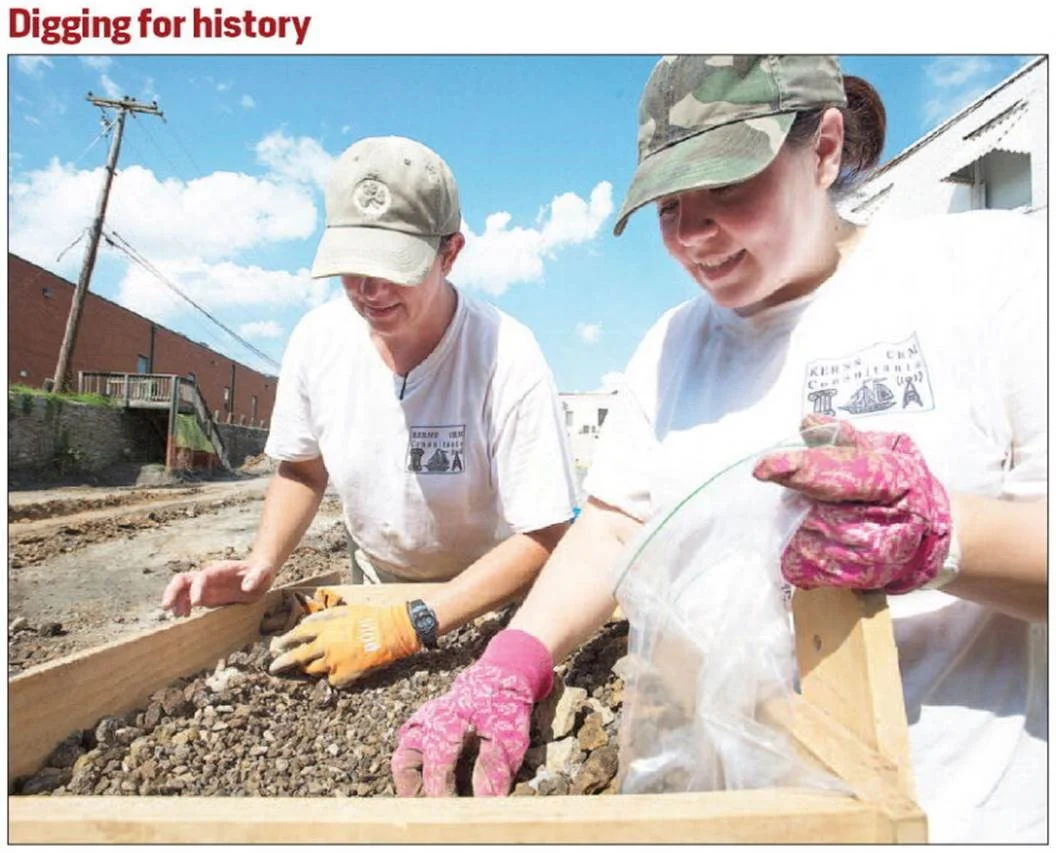
Plamondon Hospitality Partners has scheduled a Downtown Frederick Hotel: Preservation Update public meeting for Wednesday, August 17 at 6:30PM at the Delaplaine Visual Arts Education Center located at 40 S. Carroll Street. At the meeting, KANN Partners, the Preservation Architect on the Downtown Frederick Hotel Project Team, in addition to Dr. Mechelle Kearns, the project team’s archeologist, will provide a summary of the preservation related information learned about the project site to date. The public meeting also will include an opportunity for attendees to ask preservation related questions about the project.

Preservation findings will be provided to the City of Frederick and the State of Maryland as part of the project development process. The information gained will be used in evaluation and planning to develop the most effective approach to preservation, mitigation and interpretation of the historic property.

"The history of the site is important," said Pete Plamondon of Plamondon Hospitality Partners, developer of the Downtown Frederick Hotel Project, "and we are looking forward to sharing this information with the Frederick community." Plamondon added, "Our company is committed to a healthy preservation ethic, coupled with timely and open communications, in bringing this exciting project to downtown."

For more information on the Downtown Frederick Hotel Project, please visit www.downtownhotelatcarrollcreek.com.

Contact: Peter H. Plamondon Jr.
Plamondon Hospitality Partners
(301) 695-5051
petejr@plamondon-cos.com
www.downtownhotelatcarrollcreek.com