City Notes: Next workshop could be last before vote on tannery demo

Original Published August 26, 2017
Frederick News-Post

By Mallory Panuska mpanuska@newspost.com

Historic Preservation Commission Chairman Dan Lawton hopes members will be ready to vote after one more workshop on whether to allow demolition of the historic Birely Tannery building for construction of the proposed downtown hotel and conference center.

The commissioners held their third workshop Thursday on the request, which stems from plans to develop the project at 200-212 E. Patrick St. The commissioners determined in July that the early 20th Century brick tannery building and surrounding archaeological site are contributing resources to the Frederick Town Historic District, thus halting immediate demolition plans.

The developers, architects and other project partners are tasked with proving demolition of the tannery is the only logical way to construct the hotel at that site and that possible alternatives to preservation have been exhausted. They must also provide an alternative plan for preserving the historic elements of the site.

Representatives with developer Plamondon Hospitality Partners, architects Peter Fillat Architects and Bates Architects, and Richard Griffin, the city’s director of economic development, presented details of how they arrived at the decision to demolish the tannery, as well other alternatives that were considered and details about what actually exists at the site today during Thursday’s workshop.

Peter Fillat, principal of Peter Fillat architects, and Jim Mills, an architect with Bates Architects, went step-by-step through the four design options they considered, two of which kept the tannery building in place. In both, the project would lose vital parking spaces, they said.

In the preferred design, the tannery building is demolished and the site is used for parking. The project officials assured the historic elements of the site will be adequately preserved and promised to work through the process with the public and preservationists as the plans move forward.

The preferred design also includes full renovation of the historic Frederick Trolley building, which later housed the Frederick News-Post for many years. Pete Plamondon Jr., co-president of Plamondon Hospitality Partners, said he is excited about the renovation plans and looks forward to further discussing the details.

Several members of the public also spoke during Thursday’s workshop. They included several people who have consistently opposed the tannery’s demolition because of its historic significance as what has been reported the last existing tannery building in the state. Several have also expressed fear that the city is on its way to becoming an undesired commercial hub with no history left. Others included Sen. Ron Young, who is a former alderman and the mayor who championed the Carroll Creek flood control project. Young told the commission that the tannery building would be “detrimental to the hotel” and would not work in its current spot.

The commission scheduled a special workshop for 6 p.m. Thursday to continue discussing the project and demolition request details. Plamondon said he and his partners plan to focus on the design and community benefit and impact of the project during the next workshop.

Lawton said he hopes the commissioners will be able to vote after that.

“After the rest of tonight and next week hope I hope to move toward a vote on demolition,” Lawton said Thursday. “That does not mean more work does not need done on the design. I just hope to keep discussions mostly to [demolition] until we get to that plan.”

The current design proposes a hotel with four floors and 180 rooms, roughly 20,000 square feet of rentable meeting space, and about 160 underground public parking spaces.

Aldermen to vote on Mt. Olivet rezoning at next public hearing

The rezoning of a portion of land inside Mt. Olivet Cemetery for a residential project is going before the Board of Aldermen at its first September meeting.

The request to remove an institutional floating zone from a 12.74-acre portion of unused land inside the cemetery at 515 S. Market St. is the first step toward the eventual construction of roughly 90 town houses and a senior living facility on about 20 vacant acres at the edge of the cemetery.

The city’s Planning Commission voted in a unanimous 5-0 majority in July to make a positive recommendation to the board to approve it and the aldermen held a workshop at the beginning of August to discuss the details. The elected officials seemed to come to a consensus by the end of the workshop after asking some questions about traffic and the land’s original medium residential zoning. They are set to cast their final votes at the Sept. 7 public hearing.

Several neighbors have opposed the project, citing concerns about increased traffic and density if the land is developed as proposed. Several have also said they plan to continue coming to the meetings where the project is discussed and voicing their concerns.

According to the plans, the developer intends to purchase a total of about 20 acres and has applied to remove the institutional zone on the 12.74 acres to build the town homes. The senior living building is planned for the additional 8 acres close to Interstate 70 and will keep the institutional floating zone. Developers have said the senior housing facility will be marketed to senior citizens making 60 percent of the average median income.

The cemetery dates back to the 1850s and contains roughly 150,000 graves. Historical claims to fame include the final resting place of Frederick resident and Star Spangled Banner Composer Francis Scott Key and a “Confederate Row,” where 700 Southern casualties of the American Civil War are buried.

Preservation Not Just About Buildings

Original Published July 25, 2017
The Frederick Extra

By Donald Burgess

Frederick has reaped the benefits of thoughtful historic preservation over the last several decades, which has led to the rehabilitation and adaptive reuse of many residential and commercial buildings—through investments by the city, county, and state in the Carroll Creek project and the core downtown area, as well as throughout the city. Most recently, it has led to the rehabilitation and utilization of the very significant Union Knitting Mills and the Monocacy Valley Canning Company buildings.

But true historic preservationists recognize that historic preservation is not about simply preserving architecture or buildings – no matter the costs, no matter the economic impact, no matter the need for a functioning and vibrant community, no matter the needs of other historic resources. Rather, it’s fundamentally about saving historic structures and encouraging appropriate infill that drives economic sustainment and growth while preserving the "sense of place" (identity) of a community and the character of its neighborhoods.  Kennedy Smith, former director of the National Trust for Historic Preservation's Main Street Program for two decades, and one of the nation's leading authorities on economic development says this about historic preservation: "It’s not about preserving buildings, it’s about preserving community." 

Nell Ziehl, from the Maryland Historical Trust, says that "historic preservation is not just about buildings, it’s about protecting the character of those places." Steve Knight, a prominent architect in DC, says that "preservation's concern is broader than saving or reusing single structures.  It is preservation on a much larger scale. It is about preserving the sense of place of a neighborhood."

Frederick, which is the second largest city in Maryland and a major heritage tourism destination, sees nearly 1.5 million visitors each year – yet it has no downtown hotel (there is no room in the inn, because there is no inn).  Frederick County has one of the most robust economies in the Washington metropolitan areas, is home to many large businesses, and sees tens of thousands of business travelers each year – yet it has no 4-star hotel.

It is clear that the proposed Downtown Frederick Hotel and Conference Center will be of great benefit to the city – generating jobs and tax revenue while enhancing Frederick’s identity as a heritage tourism destination. This project involves not only construction of a new building that’s appropriate for the city and its character (infill), but also the feasibility of preserving the Birely Tannery in an economically sustainable way.

The fundamental question before Historic Preservation Commission is “What decision will result in better preservation of the historic character of Frederick, better completing the community fabric, better continue the amazing revitalization that has occurred over the last decade or so, and better enhance the viability and the integrity of the historic district?”  

Encouraging economic sustainment and growth through infill

Economic growth is the primary catalyst for preserving existing historic structures and encouraging appropriate infill, which leads to investment and preservation of vacant buildings, vacant lots, under-utilized parcels, and distressed historic buildings in the community. Infill also fosters the renovation of significant historic resources that—although in fair-to-good shape—are still in need of improvement and modernization. All of these activities then spur further economic revitalization, both residential and commercial, resulting in new and expanded businesses, more job opportunities for residents, and increased tax revenue. Appropriate infill induces mixed-use development, increases housing stock, and even leads to more low-to-moderate priced housing.

The Michigan State Historic Preservation Office says that "Communities interested in protecting sense of place ... are seeking ways to revitalize commercial activity and take advantage of new development opportunities that promise solid economic growth."  The National Trust for Historic Preservation sees historic preservation on a much larger and broader scale than simply preserving architecture and just saving buildings.  The National Trust's Main Street program maintains that "Historic Preservation = Economic Development." 

The Main Street program is an economic revitalization tool – its primary focus is on economic development and revitalization of main street communities which then stimulates preservation of historic resources. 

The Downtown Frederick Hotel and Conference Center clearly qualifies as an appropriate, economically feasible, and sustainable investment in the future of historic Frederick.  It will continue the revitalization of Frederick which has been significantly driven by infill construction along Carroll Creek. A decade or so ago it was said that there was "a dearth of vitality along the Creek."   Creekside Plaza, Maxwell Place Condos, South Market Center, and the Board of Education building are outstanding examples of infill construction that have transformed the city and have induced the rehabilitation and adaptive reuse of many residential and commercial buildings throughout the entire city.

Preserving and productively using historic structures

The disposition of the Birely Tannery building is more nuanced, but must be considered in the context of an economically viable plan for preserving and productively using the building. Jason Deem, a major developer and historic preservationist in St. Louis says, "If you preserve without intent for a building, you are just starting the cycle of decay again” and that "keeping historic buildings standing isn’t the point; it’s about turning them into places people want to use." Currently, the only plan under consideration for the building refers to a “Museum of Tanning History,” the operation and sustainment of which is not economically feasible. The capital costs to rehabilitate the tannery building and site and to establish exhibits plus operational costs would likely require a total budget of $150,000 to $200,000 per year.

This rivals the budget of the Historical Society of Frederick County—a very large and well-established organization with dozens of volunteers that has a much broader mandate than “leather tanning.” Those advocating today for “preservation” of the abandoned tannery building have had decades to develop a viable plan and pursue its adaptive reuse, but have not done nothing—demonstrating a lack of interest (until now) coupled with lack of an economically viable plan.

Where the rubber meets the road

Although historic preservation guidelines shape what infill and renovated properties look like, they are not a “magic wand” that CAUSES the preservation of historic resources to happen.  Economic growth is the primary catalyst for historic preservation.  Historic preservation is an economic and community development activity – sustainable and smart growth – framed in the context of historic resources.

The definition of a “resource” is a source that can be readily drawn upon and used. This definition applies to historic resources as well—there must be a concrete and economically viable use for a historic resource, or as Deem says, the cycle of decay will continue. If demolition of the Birely Tannery is not allowed, it is likely the building will simply be boarded up with a fence around it, sitting unused for another several decades just like it already sat unused for decades.  

Or maybe it will see some limited renovations, enough to become a storage building for auto parts or some other inventory.  These are  not historic preservation. It’s “kicking the can” and letting the next board or commission make the difficult—but necessary—call. This type of "pickle preservation” isn’t about preserving buildings; it’s an intolerance for change and an attempt at romantic nostalgia about relics. True historic preservation decisions are reality-based and made in the context of today. No wands involved. 

The bottom line

What decision will better preserve the historic character of Frederick?  What decision will better lead to completing the community fabric of Frederick?  What decision will better continue the revitalization of Frederick?  What decision will better enhance the viability of historic Frederick?

Hotel Plan Begins Review, Approval Process

Press Release: June 15, 2017

This morning, Plamondon Hospitality Partners, The City of Frederick and Randall Family LLC jointly took the next step required to build the Downtown Hotel and Conference Center at Carroll Creek and a related new public parking structure at 200 E. Patrick Street.
 
The three parties involved filed the application with the City’s Historic Preservation Commission. This is the first step in the review and approval process. The Maryland Historical Trust will also review the plans.  
 
The proposed hotel incorporates historic architecture and industry. Plamondon Hospitality Partners plans to restore the historic Frederick trolley station building, which was used most recently as offices of The Frederick News-Post. Randall Family LLC owns the property, which is under contract to be sold as part of this project.

The trolley building started out as the Frederick Railroad freight terminal, which included a trolley line to Thurmont and Braddock Heights. After that, the building was an office for an electrical company. In the 1950s, it was bought and converted to use for The Frederick News Post, with fully operational offices and printing on site. The application includes a request to remove the press room that was added to the trolley station building in the 1960s.

The applicants are also requesting to demolish a building at the back of the property that replaced a structure that was one of many on the site of an operating tannery until the 1920s. A fire in 1909 destroyed all but a portion of this building, leaving part of the ground floor’s south wall. The building that replaced it later became a sales office for tanned products, and in the late 40s and early 50s, it became a poultry business, slaughter and packaging site. The existing building has been reconfigured since the 1950s and suffered another fire. Most recently, it was used for residential/storage until its current vacancy in 2009.
 
The proposed hotel plan includes architectural elements and space dedicated to recognize Frederick’s association with the tanning industry.  
 
The Smart-Growth-inspired infill development project is designed to be harmonious with and complement the entire Historic District in scale, architecture and function. It will address traffic flow to and through the area by adding access points on East Patrick Street with a connection from South Carroll Street.
 
The City is partnering on the project to build new public parking, approximately 170 spaces, which will occupy the foundation level of the hotel. The City’s part of the financial agreement is only for the public aspects of the development: parking and street improvements. Plamondon Hospitality Partners will build and own the hotel and meeting space.

Press Release pic.jpg

Downtown Walkaround: Carroll Creek businesses welcome hotel downtown

Original Published May 22, 2017
Frederick News-Post

By Mallory Panuska mpanuska@newspost.com

With the prospect of a downtown Frederick hotel and conference center back in the news with the reveal of its first 3-D design model and new visual images Thursday, it is the perfect time for several nearby business representatives to weigh in on the project.

And according to those polled Friday, the project gets a thumbs up from its neighbors.

The businesses along Carroll Creek Way are within a short walking distance of the proposed hotel and conference center planned for 200 and 212 E. Patrick St.

Sweeties Ice Cream and Frozen Yogurt is one of those businesses.

Manager Nicole Endara said Friday the hotel would likely bring more business to the seasonal shop.

“I feel like it would bring business and more people,” she said.

John McCain, general manager of The Wine Kitchen next door, had similar thoughts.

“I think a hotel would be great for downtown,” he said. “Certainly the location would be great for Carroll Creek and the local businesses on it.”

He added that it would likely boost growth and tourism to the area not only with more guests staying downtown but by attracting more development.

“It would be great for the local economy,” he said.

At Windy City Red Hots on the corner of Carroll Creek Way toward East Street, owner Angel Miranda said he believes a nearby hotel and conference center would increase foot traffic to his business. The Chicago-style hot dog eatery is fairly new to the area after a January grand opening and relies significantly on foot traffic to bring people in.

“It definitely will be helpful. It should bring a lot of people down here,” Miranda said.

The new design for the planned roughly $80 million hotel and conference center includes is one floor shorter and includes fewer rooms than the most recent former rendering. It also had a plan for about 60 more parking spaces than the last rendering.

The project is planned to come to fruition through a public-private partnership with public money from the city county, state and private funds from developers Plamondon Hospitality Partners.

Like the nearby business owners, city and county officials, developers and architects expect it will boost the local economy by bringing new life to an area of downtown that has not seen much activity in years.

An historic trolley building, which housed Frederick News-Post operations from 1968 to the mid-2000s, is set to be rehabilitated into a retail area complete with a possible feature resistant and shops.

The historic Birely Tannery building at the rear of the property is set for demolition within the new design plans. Architects are tasked to develop a plan to preserve the historic elements of city tanning operations with the proposed development.

The design revealed Thursday will go to the city’s Historic Preservation Commission soon for review and approval.

Hotel plans improve with input

Original Published May 18, 2017
Frederick News-Post Editorial

It takes time to do big things. As Mayor Randy McClement observed Thursday, it has taken eight years to produce the latest vision of the proposed downtown hotel and conference center.

It’s been worth the wait.

The plan, sketches and model unveiled before a packed room at the Delaplaine Visual Arts Education Center show a project that is coming together beautifully. In its scale, in its design and even in the financing behind it all, the revised proposal shows that developers have taken account of community feedback — and criticism — in refining the project.

The new design for the hotel and conference center would be lower — four floors instead of five — and it would have fewer rooms — 180 instead of 240. The reduced mass and height of the building will preserve views of Frederick’s iconic steeples, answering a concern raised by the initial sketches. And we are especially pleased to learn that the hotel will provide public access to the rooftop, for all of us to enjoy the views.

The new design shows thoughtful consideration of the project’s setting, in the heart of Frederick’s historic downtown, along the city’s centerpiece Carroll Creek Linear Park. Parking will be underground and out of sight. Lining the creek will be the hotel lobby, a restaurant and meeting space, bringing hotel activity right to the creek. The new design is also sensitive to how the building meshes with the streetscape along Patrick and Carroll streets, reinvigorating the historic trolley building on Patrick and providing street-level access to new shops and restaurants along Carroll.

Critically, public officials and developer Pete Plamondon, of Plamondon Hospitality Partners, have clarified the role that public funding will play in bringing this project to Frederick. What opposition there has been to the project has largely centered on the use of public money. Officials emphasized that no public money will be spent building or operating the hotel or the conference center.

Public money is still required — about $30 million from state, county and city sources. It will be used for “land acquisition, grading and site preparation, utilities, on-site public parking and related off-site roadway improvements,” according to a city press release.

That’s entirely appropriate. Most of the money would be generated by the project itself, so it isn’t being pulled from other uses. That public money wouldn’t exist without the project. More importantly, this project has the potential to be transformational for downtown Frederick. It would add momentum to development all along the creek and provide a vital link between downtown and east Frederick. It would help large local businesses that need gathering spaces. And by attracting thousands of visitors downtown, the hotel and conference center will bring cultural vitality to the city — and revenue to shops and local restaurants.

In supporting jobs, tax revenue and an active, attractive downtown, this is exactly the kind of smart public-private partnership that builds great cities like Frederick. It benefits all of us, the very definition of a public investment.

There is still more to be done, of course. Among other steps, the developers will need to work with the Historic Preservation Commission to ensure their plans meet city guidelines. We trust the HPC will work productively on the project. And the developers will need approval to remove a small vacant building on the site known as the Birely Tannery.

The fate of the Birely Tannery has been another flashpoint in the public discussion about the hotel and conference center. Plamondon said removing the Birely Tannery was necessary, but that element of the city’s tanning history would be incorporated into the project. Some of that was on display at the unveiling; the architect pointed out creek-side trellises that reference drying racks used in tanning operations. That approach, we believe, offers a reasonable compromise to honoring the city’s industrial past while building for the future.

At the end of the presentation, McClement called to the front of the room some of the people who have worked to push this project forward. It was a long line of public officials and community members, too many to mention them all by name here. But it was maybe the best part of the whole event, because it showed just how many people have invested so much time and effort in making this happen. With that kind of broad support, and with the willingness to adapt to community input that was shown in the latest plans, we are confident Frederick will get the downtown hotel and conference center it deserves.

Fewer rooms, more parking, new funding breakdown included in latest downtown Frederick hotel plans

Original Published May 18, 2017
Frederick News-Post

By Mallory Panuska mpanuska@newspost.com 

                                                                      &nbs…

                                                                                                                                                                                               Staff photo by Graham Cullen

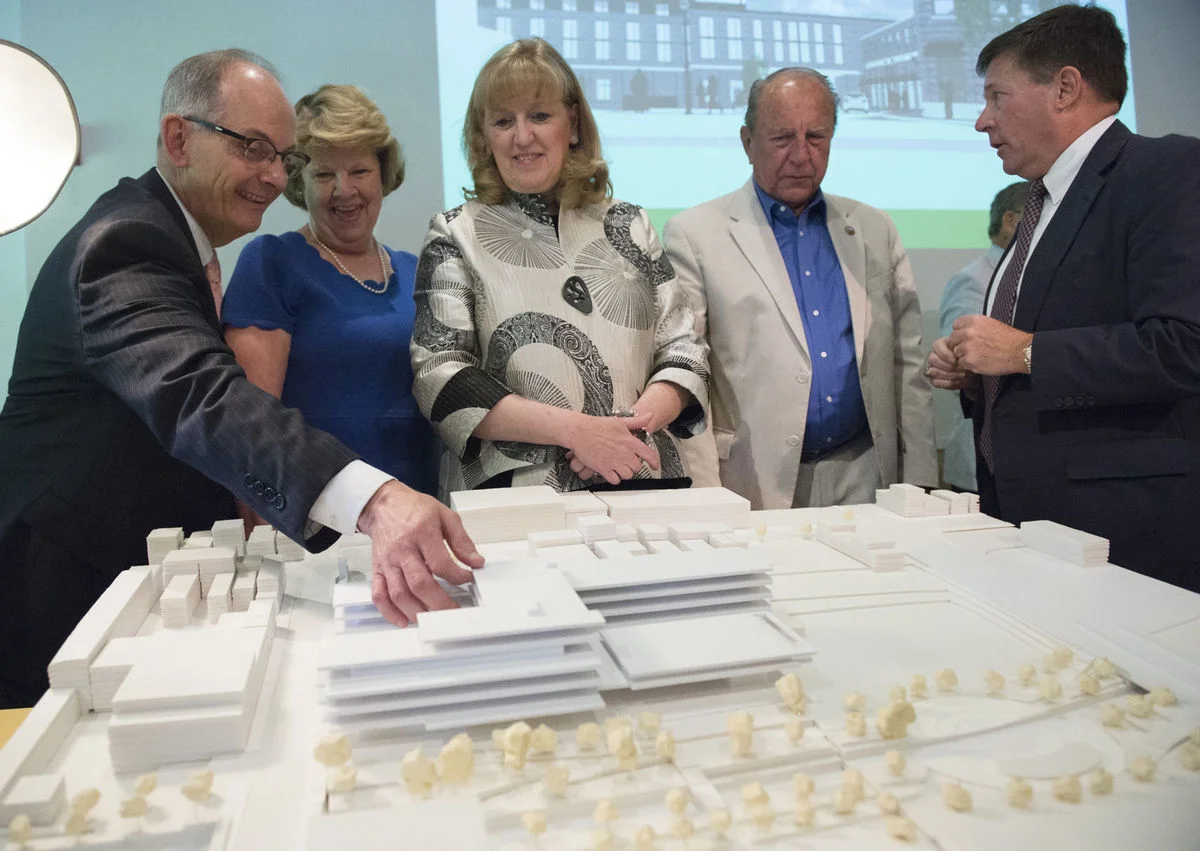
From left, Frederick Mayor Randy McClement, state Delegate Carol Krimm, County Executive Jan Gardner, County Council President Bud Otis and Peter Plamondon Jr., CEO of Plamondon Hospitality Partners, mingle after unveiling of a model of the proposed downtown hotel and conference center on Thursday at the Delaplaine Visual Arts Education Center. 

The city and county’s contribution is expected to amount to between $14 million and $16 million, depending on final design approvals.

Maryland lawmakers passed a capital budget in late March that tentatively includes $16 million in grants for the project. Through that plan the project would receive a $5 million grant in fiscal 2018. Other amendments include a $7.5 million grant preauthorization for fiscal 2019 and a $3.5 million grant preauthorization for fiscal 2020.

The money is not a sure thing yet, as the state Board of Public Works still has to release the funds. McClement said Thursday that he is working out a schedule to determine when the board will hear the request.

Republican lawmakers have opposed state funding for the project and have said they will try to keep the money from being released.


Historic preservation

The architects plan to restore the historic elements of the Birely Tannery site as they move forward with the request to demolish the building. The next step is taking the plans to the city’s Historic Preservation Commission, which architects Marty Bates and Jim Mills said should occur shortly.

Plamondon said the decision to remove the tannery building was not an easy one.

“We do not take the removal of the former Birely Tannery building lightly,” he said. “But it’s necessary as this location is the only feasible option for a full-service hotel in this economic climate.”

Officials hired Bates Architects roughly seven months ago to complete the design because of the Frederick firm’s experience and expertise in historic preservation and rehabilitation.

“We’re always interfacing with city offices, planning offices and the Historic Preservation Commission,” Bates said. “We know the players, we know the workings and we know the community.”

Bates and Mills said they plan to involve the community in future discussions about preservation of the elements of the tannery site to ensure the history is not lost.

They are also excited about the plans to rehabilitate the former News-Post building into a retail facility, which they hope will include a featured restaurant and shops.

The red brick building was constructed in 1910 and used as an all-in-one terminal, waiting room, ticket office and freight depot for the Frederick & Middletown Railway. The Potomac Edison Co. also had its headquarters there and operated a 17-mile stretch of trolley line from Frederick to Thurmont. The News-Post moved there in 1968.

“It’s a gem, architecturally speaking.” Mills said of the building. “We’re just bringing it back to life.”


A long-awaited
step forward

If all goes as planned, officials hope to begin construction by 2018, with a tentative 2020 opening.

The design unveiled Thursday was the first solid, detailed plan developers have released.

The plans have been in the works for roughly eight years, McClement said, and Thursday’s design reveal was something those who have been working on it have been anticipating for a long time.

McClement said that downtown Frederick is becoming more of a destination and a hotel of this caliber coincides perfectly with that. He and Gardner also thanked everyone who helped move the project along, including members of the Board of Aldermen, County Council, state Legislature, Frederick County Chamber of Commerce, Downtown Frederick Partnership, and Tourism Council of Frederick County.

“This hotel and meeting space will be the crown jewel and much-needed element to the infrastructure of our downtown,” McClement said. “I look forward to having everyone who is here today join us when we cut the ribbon [to open] this great facility.”

Gardner pointed out that the hotel and conference center are also expected to directly add more than 100 jobs downtown, with a potential to bring twice as many jobs across the region. The project will also boost tourism and development by attracting more people downtown.

“This project is about jobs. It’s about economic development,” she said.